

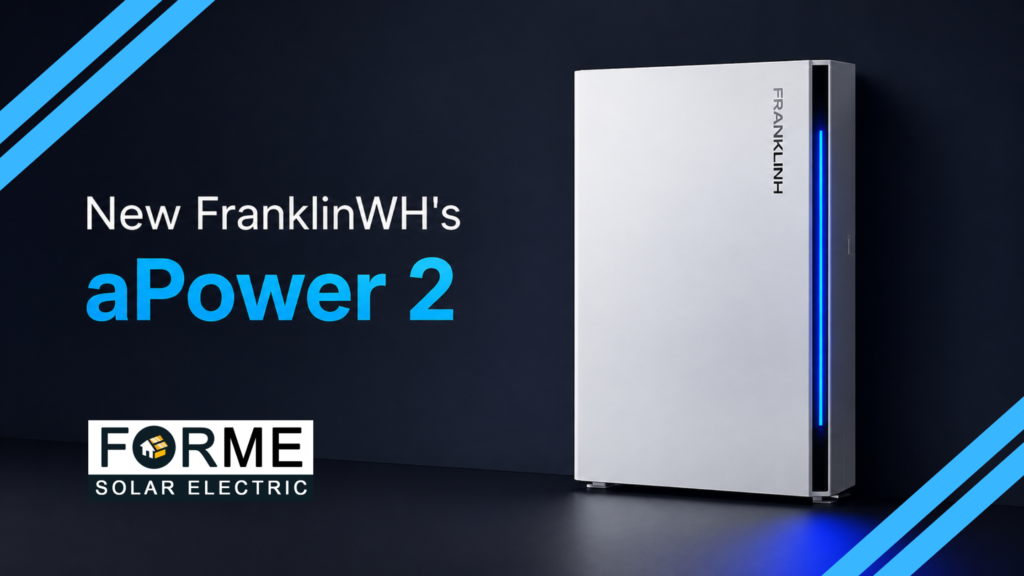
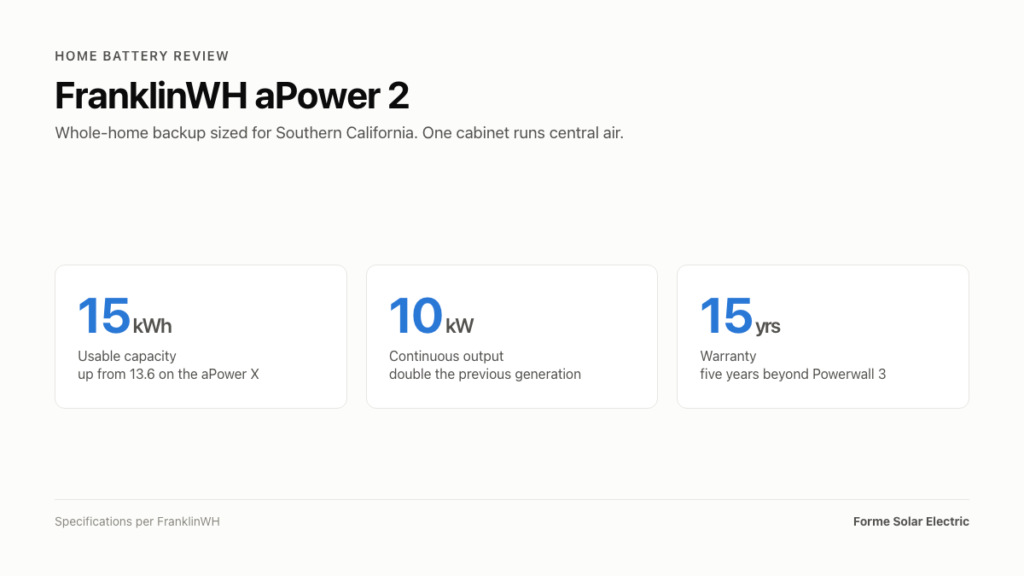
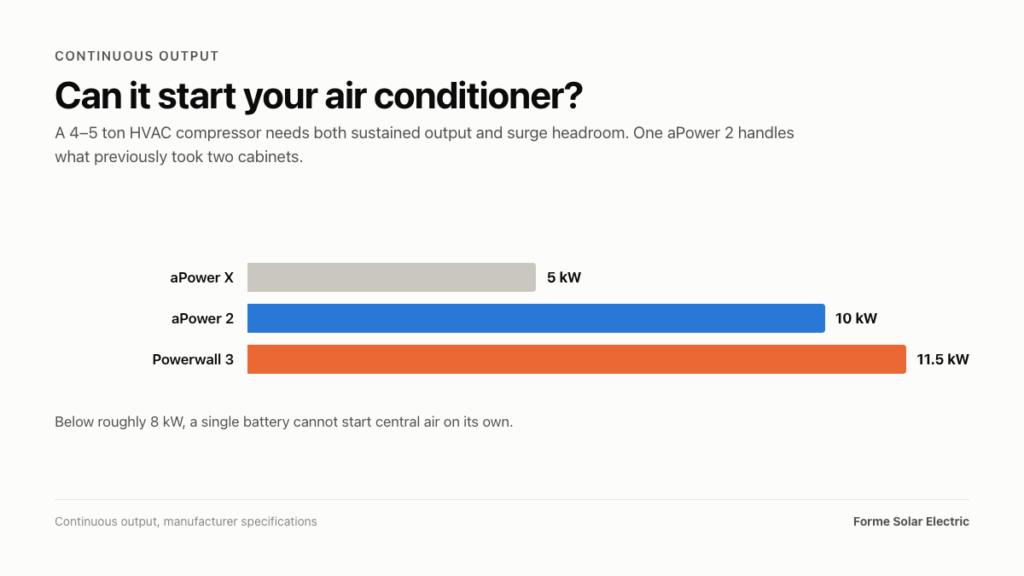
The FranklinWH aPower 2 stores 15 kWh of usable energy and pushes 10 kW of continuous power, which is enough to start and run a 4- or 5-ton air conditioner on a single battery. For most Southern California homes, that combination means one cabinet does what used to take two.
We install these. This is what we've learned putting them on walls in Orange County, the Inland Empire, and San Diego, including where the aPower 2 makes sense, where a Powerwall 3 is the better call, and what the install actually involves when you already have solar on the roof.
What the aPower 2 is, and who it suits
FranklinWH makes whole-home backup systems. The aPower 2 is the battery cabinet; the aGate is the smart controller that sits between your panel, your solar, and the grid, deciding what gets powered and when.
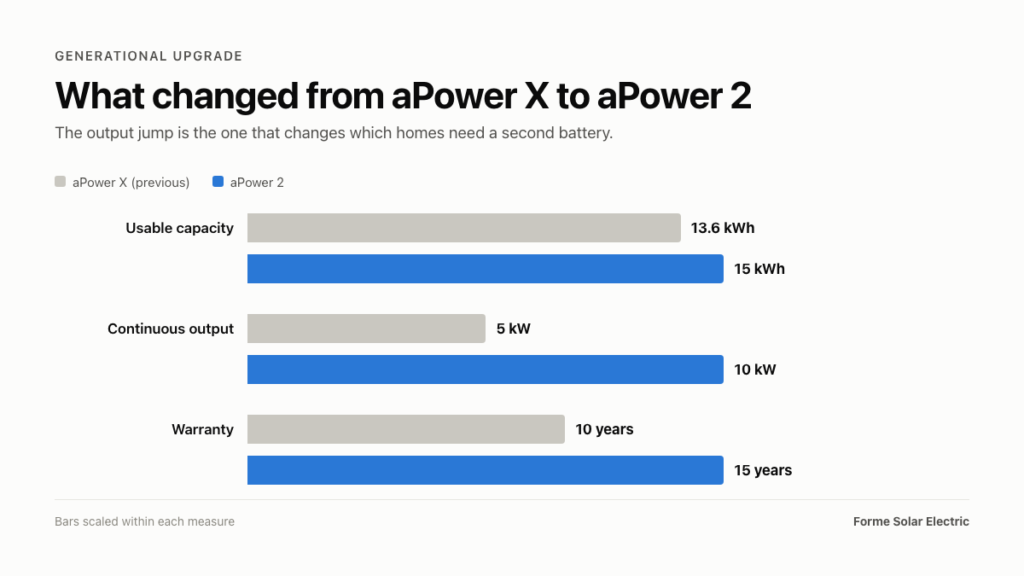
It replaced the aPower X in early 2025. The jump between generations was unusually large for a battery refresh, and it changed which homes are a fit.
The aPower 2 suits you if you have an existing solar array you don't want to touch, you need to back up air conditioning, or you want a battery that can grow later without replacing what you already own.
Specs that matter
| Spec | aPower 2 | aPower X (previous) |
|---|---|---|
| Usable capacity | 15 kWh | 13.6 kWh |
| Continuous output | 10 kW | 5 kW |
| Warranty | 15 years | 10 years |
| Coupling | AC | AC |
| Starts a 4-5 ton HVAC alone | Yes | No, needed two units |
| Stacks with previous generation | Yes | -- |
Full specifications and current configurations are on our FranklinWH battery page.
The two numbers that change real-world behavior are the 10 kW continuous output and the higher locked rotor amps rating. LRA is the surge a motor demands at startup. An air conditioner compressor pulls far more current in its first second than it does running, and that surge is what defeats undersized batteries. Doubling continuous output while raising LRA is why one aPower 2 handles a load that previously required a pair.
The install reality, which is where this battery earns its keep
The aPower 2 is AC coupled. It connects on the alternating-current side of your electrical system rather than wiring into the panels themselves.
That sounds like a technical footnote. On a retrofit it's the whole story.
If you have an existing array with Enphase microinverters or an older string inverter, an AC-coupled battery ties in downstream. Your solar keeps working the way it always has. Nobody is on the roof pulling modules or rerunning DC conductors.
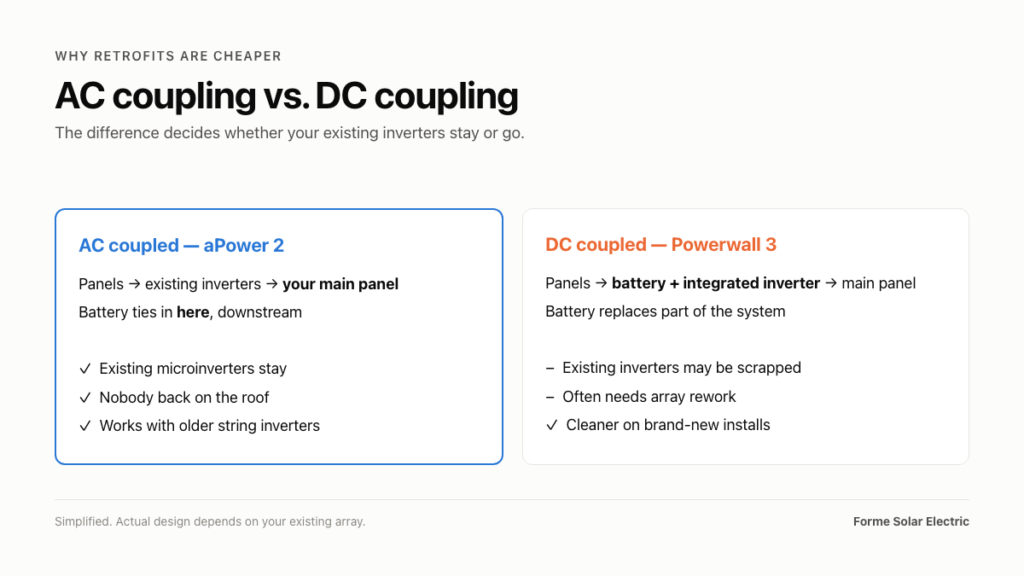
A DC-coupled battery like the Powerwall 3 integrates with the solar production side. On a new build that's efficient and clean. On a retrofit it frequently means reworking the existing system, and on some older arrays it means replacing inverters that were working fine.
We've had jobs where the AC-coupled path saved a homeowner a full day of labor and several thousand dollars in equipment they'd otherwise have thrown away. If your array is more than three or four years old, ask any installer quoting you a DC-coupled battery exactly what happens to your existing inverters. The answer changes the price.
Cross-generation stacking
If you installed an aPower X previously, an aPower 2 will pair with it. Most manufacturers don't support mixing generations, which quietly turns "add a second battery later" into "buy two new batteries later."
This matters more than it sounds under NEM 3.0, because plenty of homeowners start with one battery to cover essentials and add capacity once they've watched a year of real bills.
The aGate is half the product
Most battery comparisons focus on the cabinet and skip the controller. That's a mistake with FranklinWH, because the aGate is doing the work that determines whether your backup experience is good or frustrating.
The aGate sits between your utility service, your solar, your battery, and your main panel. It handles the transfer when the grid drops, and it manages which circuits get power and in what priority.
The practical benefit is that you don't necessarily need a separate critical-loads subpanel. Conventional backup installs often require an electrician to build a second panel and move your essential circuits into it, which is labor, materials, and a permit line item. The aGate can manage loads at the whole-panel level and shed non-essential circuits dynamically when battery reserve gets low.
On a summer evening in Corona with the grid down, that means the system can keep air conditioning running and drop the pool pump automatically rather than making you choose in advance and live with it.
It also handles EV charger integration, which matters if you have or plan to add one. An EV charger is typically the largest single load in a house, and coordinating charging against battery state and time-of-use windows is worth real money. If you're weighing that, our EV charger installation service covers how we size and place them alongside storage.
The tradeoff is complexity. There is more configuration in a FranklinWH system than in a simpler battery, and configuration done poorly produces odd behavior. Ask whoever installs it how they set priorities and whether they'll adjust them after you've lived with the system for a season.
aPower 2 vs. Tesla Powerwall 3
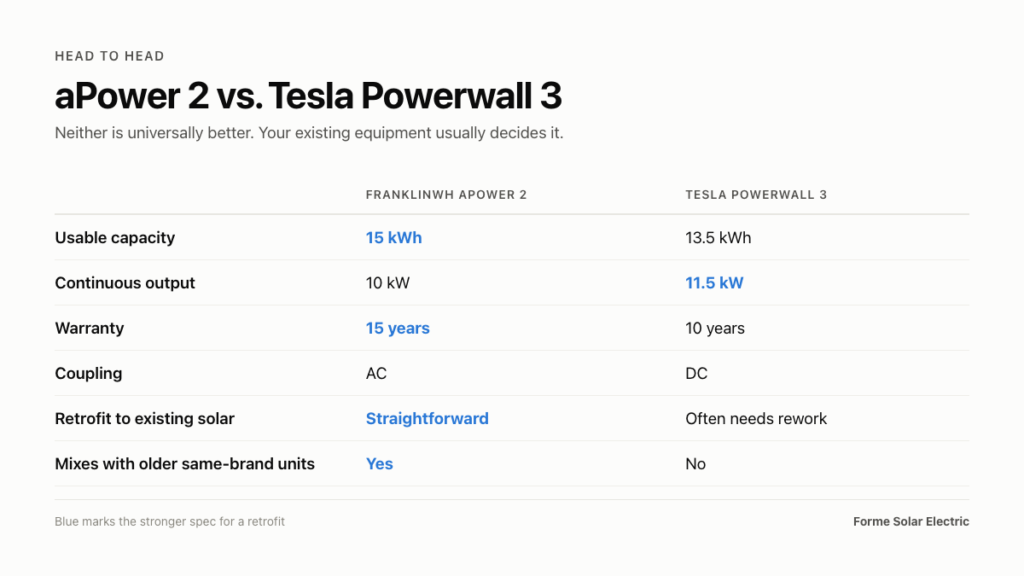
Both are good products. They're built for different situations, and anyone who tells you one is simply better is selling something.
| Feature | FranklinWH aPower 2 | Tesla Powerwall 3 |
|---|---|---|
| Usable capacity | 15 kWh | 13.5 kWh |
| Continuous output | 10 kW | 11.5 kW |
| Warranty | 15 years | 10 years |
| Coupling | AC | DC |
| Retrofit to existing solar | Straightforward | Often needs rework |
| Works with existing microinverters | Yes | Limited |
| Mixes with older same-brand units | Yes | No |
| Best fit | Retrofits, HVAC backup, phased expansion | New solar-plus-storage installs |
The five extra warranty years are worth real money. A battery is a fifteen-to-twenty year asset in a home, and the gap between a ten-year and a fifteen-year warranty lands exactly in the window where degradation questions start.
The Powerwall 3 counters with slightly higher continuous output and a tighter integrated package when solar and storage go in together. If you're installing both at once and you don't need to preserve existing equipment, it's a strong choice. Our full Tesla Powerwall 3 overview goes deeper on that side.
How it performs in Southern California specifically
Two local realities drive battery value here, and neither shows up on a spec sheet.
NEM 3.0 changed the math. Export credits under the current tariff are a fraction of what NEM 2.0 paid. Sending midday production to the grid no longer offsets your evening usage the way it once did. Storing that production and using it during the 4 p.m. to 9 p.m. peak window is now the main path to a reasonable payback. This is why battery attach rates on new installs jumped from a minority to the default. The CPUC's net billing tariff documentation has the official framing.
Time-of-use rates reward discharge timing. SCE and SDG&E both price peak-window electricity far above off-peak. A 15 kWh battery discharging through that window covers a meaningful share of a typical home's evening load. The aGate handles the scheduling; you set priorities once and mostly forget it.
Heat is the caveat nobody mentions. Inland Empire summers are punishing, and lithium batteries derate in sustained high ambient temperatures. Placement matters. A west-facing garage wall in Riverside is a worse location than a shaded north side, and we route installs accordingly. Any installer who doesn't discuss placement with you in a hot climate is not thinking hard enough about your equipment's lifespan.
PSPS and outages. For foothill and canyon communities in wildfire-risk areas, the value calculation is different. Backup capability that keeps a refrigerator, well pump, medical equipment, and air conditioning running through a multi-day shutoff isn't measured in payback years.
What it costs, and when it pays back
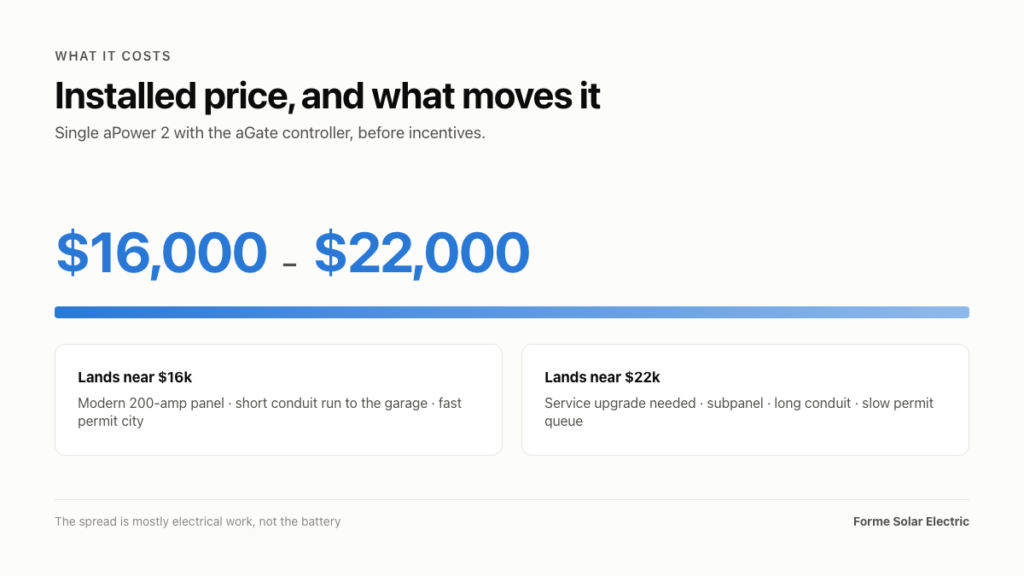
Installed cost for a single aPower 2 with the aGate typically runs in the $16,000 to $22,000 range before incentives, depending on electrical work, panel upgrades, distance from the main service, and whether we're pulling a permit in a city with a slow queue.
That's a wide range, and the spread is mostly electrical. Homes with a modern 200-amp panel and a clean run to the garage land at the bottom. Homes needing a service upgrade, a subpanel, or a long conduit run land at the top.
The federal Investment Tax Credit has applied to battery storage, but the policy landscape has shifted recently and you should confirm current status before counting on a specific percentage. We'll tell you what applies at the time you're quoting rather than what applied last year.
Payback depends on your rate schedule and consumption pattern more than on the battery. A home on a high-differential TOU plan with heavy evening usage sees a materially shorter payback than a home with low overall usage and flat consumption.
When it doesn't pencil out: if your monthly bill is under about $120, if you're on a legacy NEM 2.0 agreement that still pays well for exports, or if you're planning to sell within two or three years, a battery is difficult to justify on economics alone. Backup value may still make it worth it to you. That's a different decision, and a legitimate one, but it's worth naming which one you're making.
Sizing: one battery or two?
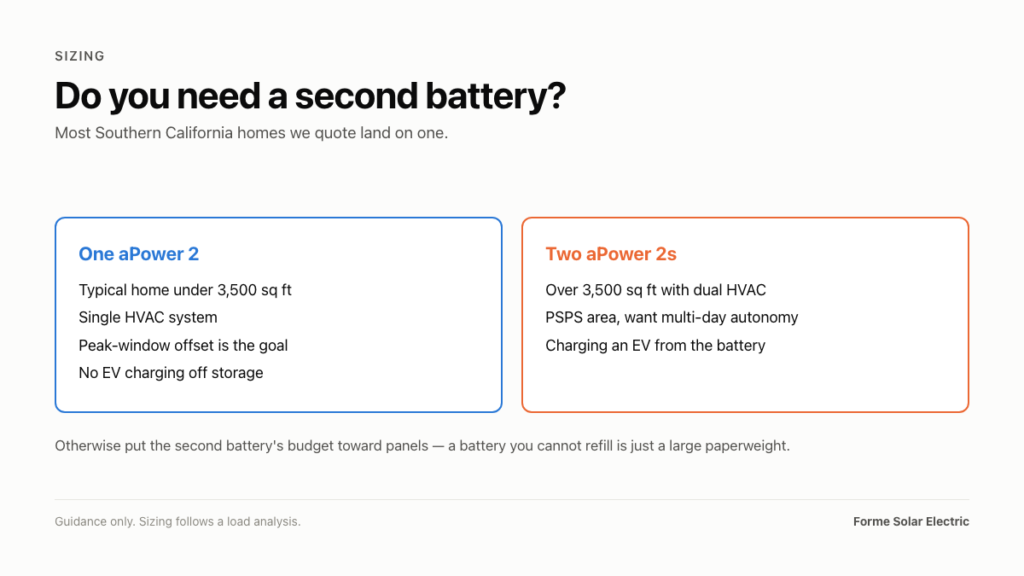
Most Southern California homes we quote land on a single aPower 2. The 10 kW output covers a typical load profile including central air, and 15 kWh gets a household through a peak window with margin.
Two batteries make sense in three situations. Homes above roughly 3,500 square feet with dual HVAC systems draw more than one cabinet comfortably supports during a long outage. Homes in PSPS-prone areas wanting genuine multi-day autonomy need the reserve. And homes with an EV they intend to charge off storage need the extra capacity, since a single charging session can consume most of one battery.
Everyone else is better served putting the second battery's budget toward panels. Generation is generally the better marginal dollar under net billing, because a battery you can't refill is just a large paperweight. If your array is undersized for your usage, expanding residential solar before adding a second battery is usually the stronger move.
Who should buy the aPower 2
Reach for it if you have existing solar and want backup without disturbing the array, you need to run central air during outages, you're in a PSPS-affected area, or you want the option to add capacity in a few years.
Look elsewhere if you're installing solar and storage together on a new system with no legacy equipment, in which case the DC-coupled integration of a Powerwall 3 is cleaner. Also consider smaller modular options if you only need to back up a handful of essential circuits. A full 15 kWh cabinet is more battery than a partial-home backup requires. Our battery comparison hub covers the modular options.
Frequently Asked Questions
How long will a FranklinWH aPower 2 run my house during an outage?
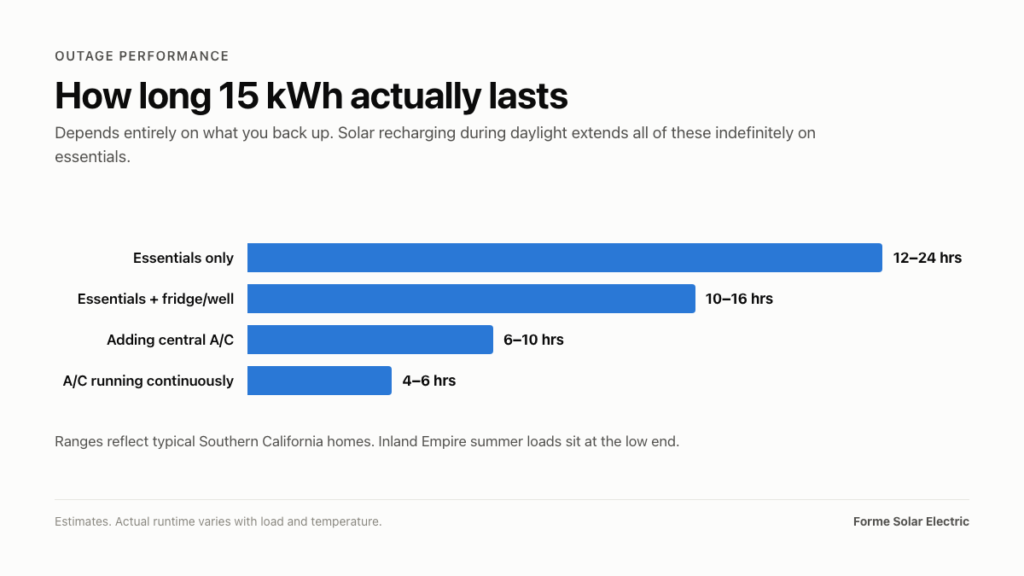
A 15 kWh aPower 2 typically runs essential loads for 12 to 24 hours, depending on what you're backing up. Running central air conditioning continuously drops that to roughly 6 to 10 hours. With solar recharging during daylight, most homes ride through multi-day outages indefinitely on essentials.
Can I add a FranklinWH aPower 2 to solar panels I already have?
Yes, and this is its main advantage. The aPower 2 is AC coupled, so it ties in downstream of your existing inverters without rewiring the array. It works with older microinverters and string inverters, which makes retrofits substantially cheaper than DC-coupled alternatives.
Is the aPower 2 better than a Tesla Powerwall 3?
Neither is universally better. The aPower 2 wins on warranty length, retrofit compatibility, and cross-generation stacking. The Powerwall 3 has slightly higher continuous output and integrates more cleanly when solar and storage are installed together. Your existing equipment usually decides it.
How much does a FranklinWH aPower 2 cost installed in Southern California?
Expect $16,000 to $22,000 installed before incentives for a single aPower 2 with the aGate controller. The range depends on electrical work, whether your main panel needs upgrading, conduit distance, and local permit costs. Homes with modern 200-amp panels sit at the lower end.
Does one aPower 2 run central air conditioning?
Yes. With 10 kW continuous output and an increased locked rotor amps rating, a single aPower 2 starts and runs a 4 or 5 ton HVAC unit. The previous aPower X required two units for the same load, which is the most practical upgrade between generations.
How long do FranklinWH batteries last?
The aPower 2 carries a 15-year warranty, five years longer than most competitors. Expect useful life beyond that with gradual capacity degradation. Southern California heat accelerates degradation, so placement in a shaded, ventilated location meaningfully affects how the battery ages.
Thinking about backup for your home? We install FranklinWH across Orange County, Los Angeles, the Inland Empire, and San Diego, and we'll tell you honestly if your existing system makes a different battery the smarter buy. Get a quote or read more about our solar battery installation service.

Recent Posts
 Freedom Forever Solar Files for Bankruptcy
 Spring Is the Sweet Spot for Going Solar
 From Solar Installation, HVAC to Roofing: Home Services Done Right
 Forme Solar Recognized as 2025 Top Solar Contractor by Solar Power World
 The Real Cost of Solar: Why Payback Periods Are Shorter Than You Think
 The Next Level in Home Battery Systems? Meet EcoFlow Ocean Pro
 The Government Just Set a HUGE Cloud Over the Solar Industry Why You Need to Act Now
 The Simple Guide to Choosing the Best Solar Panels in 2025
 Ask These 10 Questions Before You Choose a Solar Company
 Should You Get Solar Battery Storage? A Comprehensive Guide to Battery Benefits and ROI
 Sunnova Energy Files for Bankruptcy
 How Many Solar Panels Do You Actually Need? Don’t Waste Your Money
 Tesla Powerwall 3 Overview From a Certified Installer